

October 27 2026 will commemorate the 55th anniversary of the murder in police detention of Ahmed Timol, a brave and courageous fighter, who envisioned a free South Africa, for all who live in it.
This series, tells the stories of his life, his legacy and the ongoing quest for justice and accountability.
The making of Ahmed Timol: From humble beginnings to anti-apartheid resistance
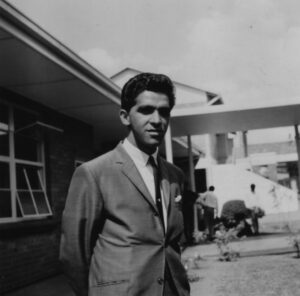
Born into a hardworking family in the then Eastern Transvaal, Ahmed Timol grew up amid economic hardship and the rising tensions of apartheid South Africa. His youth in Roodepoort and Johannesburg shaped a sharp political consciousness that guided him through his student years and into the classroom. As a teacher at the then Roodepoort Indian High School, Timol challenged state narratives, conscientising students and standing firm in his political principles. His early life reveals the intellectual and moral foundations of an activist who dared to defy the apartheid regime.
Haji Yusuf Ahmed Timol arrived in South Africa from India and settled in Heidelberg (Mpumalanga). In 1933, he married Hawa Ismail Dindar. Her father Ismail Dindar had also arrived from India and opened a retail shop in Breyten in the Eastern Transvaal (now Mpumalanga). Haji Timol worked for his in-laws in Breyten from 1934 to 1949 managing the main store, Amod and Ismail.
With coal mines and an important railway junction in the region, business in Breyten was profitable at the time. Ahmed Timol was born in Breyten on 3 November 1941. He had two sisters, Zubeida and Aysha, and three brothers, Ismail, Mohammed and Haroon. Hawa lost two babies who died at birth before Ahmed was born, and another, Fatima, died subsequently, aged just nine months.
The Timol family moved to Roodepoort in 1949, the gold-mining area of the fast-growing Johannesburg. Haji Timol was a wholesaler specialising in rice with GH (Goolam Hussein) Bhabha and he also sold khaki material at a small shop in Market Street, Johannesburg. As this business venture did not work out, the family relocated to Balfour in the South-Eastern Transvaal (Mpumalanga) where Haji Timol opened a bicycle shop.
With no high school in Balfour, Ahmed went to school in Standerton, boarding at the local hostel. After Haji Timol’s business initiative in Balfour struggled and with Ahmed falling seriously ill in Standerton, the family relocated to Roodepoort.
The Timol family were now tenants at Flat Number 2 in Choonara’s Building, 76 Mare Street. Haji Timol opened a café shop that was later destroyed by fire after he forgot to switch off the chip fryer as he was rushing off for Ramadan (fasting) prayers. Having poor eye-sight, Haji Timol underwent an eye operation as he had advanced cataracts and additional eye disorders.
Life was tough for the Timol family. Hawa sewed for additional income and her daughter Aysha was forced to leave school while in Standard Five in 1956. Zubeida had married Rashid Ahmed Chotia earlier and had moved to Machadodorp in Mpumalanga. Aysha contributed to the family’s survival by attending dressmaking and pattern-designing courses to supplement an additional income for the family.
Attending Roodepoort Primary School, Ahmed, made a speech around 1956 about Egypt’s President Nasser Hussein nationalising the Suez Canal. The teacher, Mr Baker warned him that his speech was political. As there was no high school for Indian students in Roodepoort, Ahmed travelled by train to complete his secondary school at the Johannesburg Indian High School. After matriculating with a senior certificate with a matric exemption in 1959 (aged 18), Ahmed spent a year with Goolam Mohamed Ahmed Khota (Goramota), one of the very few non-white bookkeepers in the 1950s and 1960s.
He provided free bookkeeping lessons to students all over the country, at no cost. This was unique as Goramota paid his students as they worked and there were no financial reward for him.
After obtaining a scholarship from the Kholvad Madressa, Ahmed did a teaching course at the Johannesburg Training Institute for Indian Teachers, the only institution of higher education for Indians in the province of Transvaal (Gauteng) at a time when political movements were illegal and all forms of mass struggle banned.
This did not deter Ahmed. Between1962 and 1963, he was elected vice-chairman of the Students’ Representative Council. In the same year, the college union became affiliated to the National Union of South African Students despite college authorities threatening to victimise those associated with the union. When specialised subjects such as Mathematics, Afrikaans and History were introduced in 1962, Ahmed refused to take Afrikaans as he viewed this as the language of the oppressor. On another occasion, a lecturer referred to him as a “bloody communist”, while chasing him around a table.
In his final speech at the college, Ahmed focused on the conditioning and brainwashing of students, appealing to them to “learn to think” and to “read the media”.
After successfully completing his teacher’s diploma in 1963, he took up a teaching post at the Roodepoort Indian High School (RIHS) until 1966.
On 9 September 1964, Suliman Saloojee (Babla) died in police detention after falling 20 meters from the seventh-floor window of the Johannesburg Security Branch police headquarters, the Grays, on the corner of Von Wielligh and Main Streets. Police claimed he committed suicide by jumping, making him the fourth detainee to have died in police detention. Ahmed attended the funeral, not knowing that seven years later, a similar fate awaited him.
In January 1964, Ahmed’s close friends Aziz and Essop Pahad were banned for five years and in December they went to London on an exit permit.
Despite his stutter, students at the RIHS viewed Ahmed as one of the most popular teachers. He was always the first to greet them and he treated them equally, irrespective of their family backgrounds. He did not believe in failing his students and constantly reminded them that their parents were the breadwinners for their families.
Ahmed used every opportunity to conscientise his students at the apartheid-government controlled school. He deviated from the prescribed textbook of South African history and introduced what he considered to be the true perspective on South African history. The School Incident Book recorded that A Timol ‘would not be able to attend the Republic Festival to be held at the Union Stadium on 11 May 1966, because of strong personal convictions’.
* Imtiaz Ahmed Cajee is the nephew of Ahmed Timol and author of Timol – Quest for Justice (2005) and The Murder of Ahmed Timol – My search for the Truth. He is currently working on publishing his 3rd book. He is writing a series of stories to commemorate the 55th anniversary of the murder in police detention of Ahmed Timol.
