
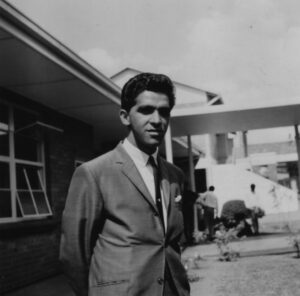
His path to achieve recognition, through his associations, has not been one strewn with flowers – his has been an uphill struggle, hindered and hampered at every turn.
His “path” has revealed major obstacles. Above all, his associations have found themselves compelled to tread on dangerous terrain, a terrain that has revealed sharp stones and other obstructionist elements, thus making progress difficult. But in spite of these imposed hardships and with abundance of patience, strength and together with his associations, he has successfully negotiated the “path” destined for international recognition.
The words of Nehru that “Success only comes to those who act bravely and boldly and never to the timid” must have been firmly rooted in the minds of our sportsmen and administrators during their days of trials and tribulations.
We are immensely proud of the achievements of our non-white sportsmen, who have stamped their names in international sporting circles. We are proud of them because they have been instrumental in spotlighting the attention of the dilemma facing our sportsmen in their fight to compete as true representatives of all South Africa within the arena of international sporting events. Our hearts go out toa man like Precious McKenzie, the weightlifting hero, who has virtually sacrificed his career, a career which should have yielded him rich rewards and international fame, because he stuck to his principles that he would represent all of South Africa in inter-national events and not only a section of the population.
In the golfing world, we have our own Papwa, who has successfully crashed the barrier to participate in national golfing events within the country and his success overseas, particularly in the Dutch Open. In the boxing arena, who can challenge the reputation gained by “Schoolboy” Nhlapo, Levi Madi, Joe Ngidi and the one-time Empire lightweight champion Jake Tuli?
On the athletic track, the half-milers Humphrey Kosi and Benoni Malaka are today the top athletes in our country. On the tennis court, David Samaai, Jasmat Dhiraj and a host of others have proven themselves over and over again.
On the other hand, we find cricketers Oliveira, Abrahams and soccerites Johannesen and Steve Mokone have left our country to become sporting exiles and who are presently gaining tremendous prestige and reputation for their sporting prowess. These are a few of the present sportsmen, but what about those who have lapsed into retirement and those who have died obscured and forgotten by the passage of time? And what about those yet to come, those future sports-men who are still young and eager, who must be nursed and trained and must yet face up to the rigours of competitive sport?
We solemnly ask, must their sporting life be jeopardised because of humiliating affiliations and lack of facilities and thus become victims of political machinations?
Must these sportsmen of the future be deprived of sports just because they do not belong to the “right” associations? Must their associations be arbitrarily kicked from the use of their grounds, which were properly administered and controlled for over 30 to 40 years because they refuse, on matters of principles, to subject themselves to subservient affiliations?
We ask these questions because national sports in our country have reached a crucial stage. A situation has arisen where we find our country either suspended or expelled from the sporting fraternity of the world. Suspended from the Olympics and Fifa and threats of expulsion hanging over tennis, swimming, weightlifting, amateur boxing, cricket as well as all other national sports.
It is an inborn human urge that a time comes when one asserts one’s human rights. Similarly, in the sporting world, the day has dawned when our sportsmen are asserting their rights for recognition. They are excelling in sports; their records and deeds justifies them to compete in international events. We therefore call upon the white sporting administrators that the ball is at your feet; it is up to you to square up to the realities of the dilemma facing South African sports.
It is up to you to decide whether to sacrifice national sports at the altar of traditional policies or whether to pursue bold, progressive policies. Policies, which are within the mainstream of enlightened thinking in the world today.
One thing is sure, that if enlightened policies are infused into sports, a long lease of life for sports is well assured. On the other hand, the application of traditional policies will undoubtedly contribute to the immediate death of any hope to compete with other countries or to participate in international events – the door will be firmly closed in our face.
Traditions are good as long as they do not hamper progress, but once progress is hampered, and in this case the progress and very existence of our sport is threatened, traditional policies should be quickly done away with.
* This article by Timol was published in the souvenir brochure of the Dynamos Soccer Festival, held in September 1965. Timol was a Football Administrator for Dynamos, named after Dynamo Moscow.
